
Watching an eclipse is a wonderful experience, but the Sun emits infrared and ultraviolet radiation that can burn the retina in a matter of seconds if strict precautions are not taken. Here are the golden rules:
Essential protection: solar eclipse glasses
Forget about ordinary sunglasses, tinted lenses, X-rays or old CDs. None of these methods blocks enough radiation.
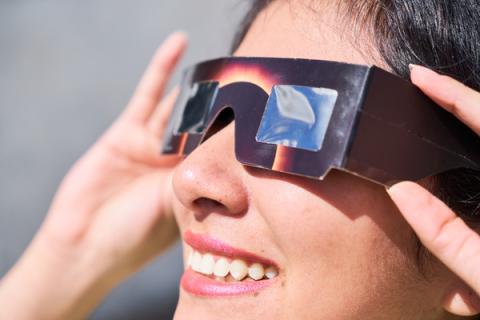
- What to wear: You must use eclipse glasses that are ISO 12312-2-certified and have not expired.
- Check before use: hold them up to the light to check for scratches, tears, holes or damage. If they are damaged, don't use them and dispose of them appropriately.
- How to use them: put the glasses on before looking at the Sun, look briefly for a few seconds and then look away; repeat your observation of the eclipse, always taking breaks in between, and never look at the eclipse for more than three consecutive minutes. Only take them off once you have diverted your gaze from the Sun. If you wear prescription glasses, place the eclipse glasses over them, holding them in place with both hands so they do not move. For children wearing glasses, adult supervision and even assistance in holding the glasses is recommended. If you wear contact lenses, use the eclipse glasses over them as usual.
- When to take off your glasses: this is the most important distinction depending on the type of eclipse:
- Eclipses of 2026 and 2027 (total): We recommend that you keep your glasses on at all times. It is only safe to take off your glasses during the minutes of totality (when the Moon covers 100% of the Sun and it becomes dark). As soon as the first ray of light appears (the 'diamond ring'), you must protect your eyes immediately.
- 2028 eclipse (annular): It is NEVER safe to look without protection. Even at the peak moment, the 'ring of fire' continues to emit enough direct sunlight to damage your eyesight. You must keep your glasses on at all times.
Optical instruments: extreme danger
- Never look directly at the Sun through binoculars, telescopes or cameras without a professional solar filter fitted to the front (lens) of the device.
- Fatal mistake: never wear eclipse glasses over the eyepiece of a telescope. The lens concentrates light and heat, which will melt the glasses and burn your eye instantly.
Indirect projection (the safest option)
If you don’t have certified glasses, don’t look back into the Sun; look down at the ground:
- Projection: make a small hole in a piece of card and let the light shine onto the floor or a wall. You will see the outline of the Sun projected.
- Nature: take a look at the shade cast by the trees; the leaves act as tiny pinhole cameras and project hundreds of little crescents onto the ground.
Visual signs and symptoms
- Looking directly at the sun during an eclipse without protection can cause solar retinopathy, a form of solar eye injury that can lead to blurred vision, distortion and/or a central blind spot (scotoma), making activities such as reading difficult. In some cases, exposure has been linked to macular holes, a hole in the central part of the retina (the macula) that may require surgery.
- The signs and symptoms of eye damage caused by an eclipse are NOT immediately apparent; they may take hours or even days to appear.
- Remember: looking at the eclipse for just a few seconds at a time without protection can lead to cumulative exposure and cause damage.
- Just because it doesn't hurt doesn't mean it's safe or that there hasn't been any damage to the retina.
How do you know if your eclipse glasses are safe?
In summary, our recommendations are as follows:
- Compliance with the ISO standard must be clearly indicated. Look for the inscription “EN ISO 12312-2:2015” on your glasses, their packaging or instructions. If it only says “ISO 12312-1” (general use), they are not suitable for looking at the Sun.
- If you have bought them in the EU, they must bear the genuine CE marking, not simply printed or stamped and without further justification.
- Look at the labelling. The manufacturer's name, warnings for safe use, clear storage instructions and, if applicable, an expiry date should be provided.
- Examine the glasses physically. If the filter is scratched, loose, bent, has lighter areas or has any noticeable defects, those glasses should not be used. A single weak spot can let in enough light to damage eyesight.
- Research reliable sources. Organisations such as planetariums, astronomical associations or scientific bodies often recommend distributors or products that have passed quality controls.
What does ISO 12312-2 require?
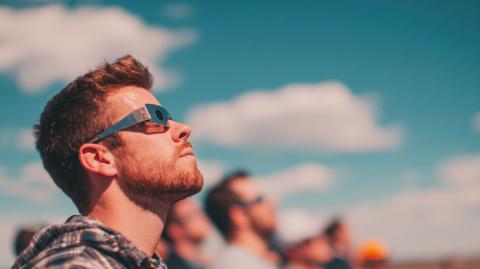
The international standard EN ISO 12312-2:2015 establishes the safety requirements that must be met by glasses tailored specifically for sun gazing, such as during an eclipse. This standard is different from ISO 12312-1, which regulates normal sunglasses, and only 12312-2 is valid for direct sun gazing.
According to this standard, the filter must block almost all visible solar radiation: it must let through at most 0,0032 % and at least 0,000061 % of visible light. In addition, it must also effectively block ultraviolet (UV) radiation and limit the amount of infra-red (IR) radiation passing through the material. The light must be evenly distributed over the entire surface of the filter, and the filter must be free of scratches, bubbles, stains or any defects that may allow more light than required to pass through.
Fitting is also important: the goggles should cover both eyes at the same time and be made without sharp edges or irritating materials. Regardless of whether they are presented in a frame (like normal spectacles) or as a film in a cardboard holder, they must hold the filter well so that it does not come off easily.
Finally, the standard requires that the glasses include clear labelling with the manufacturer's name, instructions for use, warnings about the dangers of staring at the sun without protective glasses, in case the material is not durable, an expiry date.
What does the CE marking mean?
If the glasses are sold in a country of the European Union, they must bear the CE marking, which guarantees that the product complies with European laws and regulations on personal protective equipment (Regulation (EU) 2016/425).
But the CE marking is not just a symbol: it must be backed up by laboratory tests. The manufacturer shall have carried out tests that demonstrate that the glasses meet all the requirements of the ISO standard. Without these tests, the CE marking is not valid, even if it is printed on the product. In addition, the CE marking must be visible, legible and indelible.